Interview by Matt Ashton
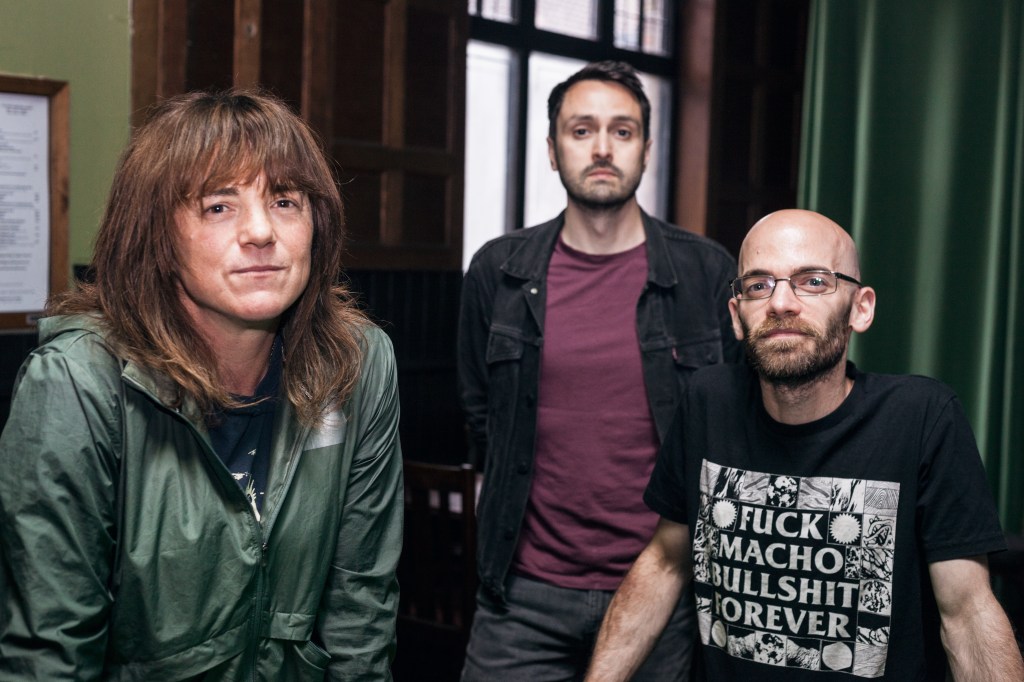
Making music in various forms since the early 90s, Schande (Sharn-deh) deal in gloriously fuzzed-out guitar pop; quiet/noisy songs, catchy but never predictable, that fold in influences from all the best college/art rock and post-punk you can name (Breeders, Throwing Muses, Sebadoh, Siouxsie Sioux etc). On the eve of the release of their debut LP Once Around – out this week via Thurston and Eva Moore’s Daydream Library Series – I spoke to singer and guitarist Jen Chochinov about writing the album, open tunings and falling for Throwing Muses (plus falling into Thurston Moore’s new band).
“I’m incredibly proud of this record… it’s one of the first things we’ve done where some time has passed and it doesn’t grate on me!” says Jen, a little surprised. Faint praise perhaps, but something to be expected from a thoughtful artist that’s taken until now to feel ready to put an album together.
The band have been through several iterations over the years, as well as existing at various points in different countries, losing songs and members with different line ups, before settling on this current version; Jen (guitar, vocals) from the US, joined by Gio Villaraut (bass) from Italy and Ryan Grieve (drums) from Canada, all outsiders in a new country. “It took this long to get the songs and consistent band members together”, she says, explaining why now for the record.
The limitations of a three piece, however, seem to have played a positive role in the current material. “In becoming a trio I had to change the way I was writing again… we’ve been playing music a long time, sometimes you get used to what you do and it’s hard to surprise yourself so it was perfect timing for me because I was feeling really bored”.
The album is a perfect 30 minute blast of melodic distortion, impressionistic yet emotional lyrics and a rhythm section that rolls through the hills of guitars like weather patterns. Sometimes it comes down in sheets, sometimes it’s walls but there’s always a melodic thread with just the right turn of chord and, like all the best art, it feels like it arrived fully formed. Clearly a product of a band highly attuned to one another, written via rehearsal room collaboration, it’s a pleasing advocate for that most maligned of terms, the ‘studio jam’.
“I’m at my creative best when it’s just in the moment, and there’s nothing better than sharing that, we all do really well in the moment”, says Jen. “The songs don’t exist without the three of us and it’s very rare that I’m actually like ‘this is how it goes’. so even if I bring in something it’s always subject to change – it’s my favourite thing watching that happen.”
Live, the band are incredible; loud, sprawling but super tight, every element as musical as the other, each instrument a whole song onto itself. “Without fail, after a gig someone will come up to me and say ‘oh my god, your bass player’ or ‘oh my god, your drummer’’, says Jen, proudly. “I don’t need my ego stoked – the fact that they’re both playing with me says enough, you know? We’re a band, not just people that play together… those two give the songs such life”.
A few years back Jen was surprised to receive an online message from a certain T Moore, asking if she wanted to join his group for a performance of 12×12 (12 players each with a 12 string guitar) at the Barbican. That turned into another show at Cafe Oto and grew into a collaboration that went on to include tours and recording songs for the Thurston Moore Guitar Ensemble’s Spirit Counsel album.
“We were recording with the Ensemble in Belgium and I was doing the thing that I hate people doing… ‘oh, there’s a guitar, everyone wants to hear me play right now’. I was just playing about, trying things, using pedals I’d never used before, I had no idea Eva (Thurston’s partner and label co-owner) was recording it. She put it online – it took me a while to realise it was me – it was after that that I was invited to do a 7” and then a full record. I said ‘er… yes please!’”.
Playing with the group was an incredible experience, says Jen, “standing on stage with Steve Shelley, Thurston and Deb Googe… teenage me would have been just, ‘what is going on?’”, and gave her the confidence to strike out more with unconventional song writing methods, including new guitar tunings.
“I was bored with standard tunings, it all felt predictable, I knew what I was going to play before it happened”, she says. “A friend showed me some new tunings, ones where you can just breathe on a guitar and it sounds great. I thought ‘oh my god, I don’t know what I’m doing’ and it’s when you don’t know what you’re doing that all the happy accidents happen, the best mistakes turn into the best ideas and it gives new life and new energy.”
You can hear that open string, widescreen sound on the excellent Apogee, sounding like it’s being beamed directly from Fort Apache studios, as well as the influence of Moore’s former group on the incredible Double Hackner, written shortly after her time in the studio with him. “You can obviously hear Sonic Youth in there” she says, “you’re fooling yourself if you don’t think you’re the product of something else, we’re all taking a conversation we heard and adding our own voice to it”.
The lyrics too, seem to be arrived at in an exploratory way rather than through a desire to explain something. “Sometimes you see a band and they tell you what the song is about and, yeah, that’s what the song is about.. no more mystery! I like using syllables to create a feeling… letting the phonetics do the work. It’s not experimental poetry but it’s finding out how we can get creative with this.”
A big influence from an early age was Throwing Muses. Sneaking down to the TV room after hours, the teenage Jen was “paralyzed, in an awestruck way” after catching them on late night cable television. “I didn’t know sound could exist like that, it was so life-changing, there’s obviously something feminist about them, writing songs when they were 14-15 years old. What spoke to me was ‘I’m just going to get up here and do my shit’ – seeing that at a young age was inspiring”.
Kristen Hersh’s lyrics as well helped map out a way for the future songwriter. “I have no idea what her words mean but they feel like home… you don’t need to be a literal storyteller to pull someone in and have them feel what you are trying to convey. That’s my comfort zone with writing, the lyrics aren’t literal”.
As Jen says though, sometimes simple words can be all the song needs, no more so than the line ‘I have a hand for your heart’ from the poignant drift of Relevant Campaigns, the song she says is most aligned with her mother’s death last year.
“When someone you love is suffering there is such a feeling of helplessness, you can’t take their pain, you can’t fix it. Relevant Campaigns was an attempt at dealing with how hard that is, how to try and hold onto something that gives you hope. That song is special to me, because of the origin; it’s a re-writing of the song I was noodling on in Belgium when Eva overheard and recorded me. I’m proud of it and I’m proud that it is a way for me to remember my mom, that she got to hear it and loved it… I think it’s one of the best songs I’ve ever written”.
Such statements are rare from Jen, ever humble and always ready to cede credit to another, and it’s something that’s reflected in the album. Never bombastic or overwrought, it’s something you can both revel in – in the clouds of distortion (Palimpsest, 52hz) and exploratory drums (check the Billy Ficca-like fills at the apex of Double Hackner) or be forced to lean in close to and decipher (Relevant Campaigns, the wordless conversations of Derek and Last Horse). The latter is a favourite of Jen’s, a “beautiful accident, a cool exercise in repetition… ‘how much can you get away with?’”.
Other themes on Once Around (an album titled, in an act of precise balance, by a line from Best In Show) centre on notions of personal experience and subjectivity, or, as Jen says, “How fully do we show up for other people or as ourselves? The way that we do or don’t recognise each other’s reality is something that I think about a lot”.
She mentions two writers named as influences on the album; Adriana Cavarero and Hannah Arendt, in particular the latter’s concept of disclosure. “It’s up to us how we reveal ourselves to people, we can tell people what we are all we want, but it’s how we act that will affect how people think of us.”
This, particularly in today’s current climate of global disharmony, seems incredibly pertinent.
“As Adriana Cavarero says, we don’t experience subjectivity until we hear our own story narrated back to us… so what happens when we don’t acknowledge what people have experienced? Even if it’s a painful reality you acknowledge, what a gift that can be.”
It’s this sense of looking out, and looking out for other people, that is one of the main reasons the album works so well. Made by a community of in tune people from different places, it’s a testament to an open world view and a kind heart. Literate without being wordy, heavy without being macho or bombastic, the album’s occasional discordance and weighty subject matter is undercut by simple, pure fun. Once Around is a joyful, moving and assured album from a band that have earned the right to take their sweet time about things.
Once Around by Schande is out on Friday 27 September on the Daydream Library Series. Visit https://linktr.ee/Schande to buy.
 heavymetalkids.uk